Why Manufacturing Digital Transformation Fails (And How to Get It Right)

Author : Arul Selvan 4th Mar 2026
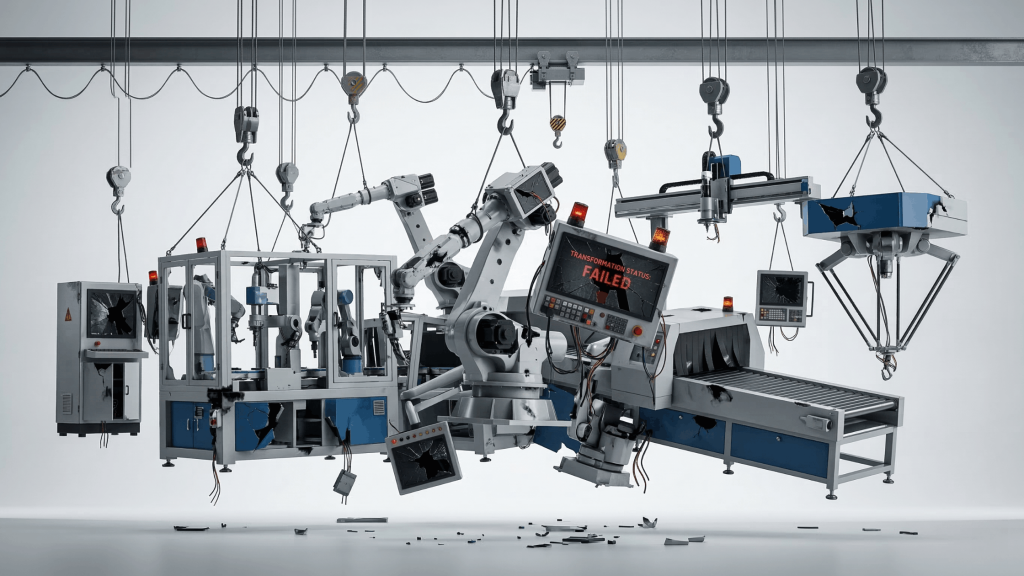
Picture this: A manufacturing executive just invested $8 million in a smart factory initiative. Six months in, the data still doesn’t flow between machines and the ERP system. Production reports take three days to compile. And the team is wondering if they wasted the budget.
Sound familiar? You’re not alone.
The manufacturing industry isn’t short on digital ambition. But there’s a massive gap between installing sensors and actually using the data they generate. According to recent industry research, only 27% of manufacturers are investing at scale in Industrial Internet of Things (IIoT), and just 29% are deploying cloud solutions meaningfully. The rest? Stuck between legacy systems and unrealized potential.
The Real Problem Isn’t Technology
Here’s what most consultants won’t tell you: the tools work fine. The issue is how manufacturers are trying to use them.
When you bolt AI onto a system that can’t even standardize part numbers across three facilities, you’re not going to get intelligent insights. You’re going to get expensive noise.
The core challenge is structural. Manufacturing operations sit on layers of technology that were never designed to talk to each other. Your programmable logic controllers speak one language. Your manufacturing execution systems speak another. Your enterprise resource planning platform speaks a third. And somewhere in between, critical production data vanishes into spreadsheets that someone updates manually every Friday.
This isn’t a data problem. It’s an architecture problem.
What Actually Breaks Down
Let’s get specific about where things fall apart. Most manufacturers face some version of these issues:
Disconnected equipment. Machines produce data, but that data doesn’t reach the systems that could act on it. Sensors capture temperature fluctuations or vibration patterns, but by the time someone notices, the damage is done.
Inconsistent definitions. What one plant calls “downtime,” another calls “changeover.” When you can’t agree on basic terminology across locations, you can’t aggregate performance metrics or compare efficiency.
Manual reconciliation. Production teams spend hours compiling information from multiple sources just to answer basic questions like “Why did output drop last Tuesday?” When data lives in silos, every analysis becomes a research project.
Limited visibility into root causes. Something goes wrong on the line, and teams scramble to figure out why. Was it a material quality issue? A calibration drift? An operator error? Without connected systems, you’re guessing.
Invisible micro-losses. Small stoppages don’t trigger alarms, so they don’t get logged. But over a quarter, those two-minute delays add up to hours of lost production.
These challenges don’t exist in isolation. They compound. And the longer they persist, the harder it becomes to justify further investment in digital tools.
Why Half-Steps Don’t Work
Many manufacturers try to solve these problems by layering new software on top of old infrastructure. They’ll deploy a dashboard here, add a reporting tool there, maybe pilot a predictive maintenance app in one facility.
It doesn’t stick.
Why? Because you’re addressing symptoms, not the underlying condition. If your operational data isn’t structured, accessible, or trustworthy, no amount of visualization will make it useful.
At TechAffinity, we’ve worked with manufacturers who spent six figures on analytics platforms that nobody uses. Not because the platforms are bad, but because the data feeding into them is unreliable. Garbage in, garbage out.
The solution isn’t more tools. It’s better integration.
A Smarter Approach to Digital Transformation
So what does work? A strategy that starts with connectivity and builds upward.
Step one: Connect the shop floor. You can’t optimize what you can’t see. Start by ensuring that critical equipment is reporting data consistently. This means standardizing protocols, establishing reliable edge computing infrastructure, and creating a unified namespace where data from different machines can be compared and correlated.
Step two: Align IT and OT systems. Your information technology and operational technology environments need to speak the same language. This isn’t just a technical challenge, it’s an organizational one. You need clear ownership, shared KPIs, and a roadmap that accounts for both legacy constraints and future scalability.
Step three: Build a data foundation. Before you deploy AI or advanced analytics, make sure your data is clean, consistent, and contextualized. That means defining standard attributes for assets, processes, and events. It means implementing data governance practices. And it means creating systems that validate information at the point of entry, not weeks later during a quarterly review.
Step four: Enable real-time decision-making. Once you have reliable data flowing through connected systems, you can start automating responses. Predictive maintenance alerts. Automated quality checks. Dynamic scheduling based on actual conditions, not static forecasts.
Step five: Scale incrementally. Digital transformation doesn’t happen overnight. Start with high-impact use cases, maybe improving Overall Equipment Effectiveness (OEE) in a single line or reducing changeover times in a specific cell. Prove the value. Then expand.
This approach isn’t flashy. But it works because it’s built on operational reality, not vendor promises.
What This Looks Like in Practice
One of our clients, a mid-size manufacturer in the automotive supply chain, faced a common challenge: they had modern machines generating terabytes of data, but no way to extract actionable insights from it.
Their first instinct was to buy an analytics platform. We suggested they pause and fix the connectivity layer first.
We helped them implement a unified data architecture that standardized how information moved from sensors to systems. We integrated their manufacturing execution systems with their ERP platform. And we built dashboards that surfaced real-time performance metrics without requiring manual data entry.
Within three months, they cut reporting time by 70%. Within six months, they identified and eliminated recurring quality issues that had been invisible before. And within a year, they reduced unplanned downtime by 18%.
The tools they used weren’t exotic. The difference was in how they were deployed, strategically, not reactively.
The Talent Challenge Is Real
Even with the right systems in place, manufacturers face another hurdle: people.
Nearly half of manufacturing companies report difficulty filling production and operations roles. And the shortage is even more acute for positions that require IT/OT expertise, data science skills, or analytics knowledge.
This is where working with an experienced partner matters. TechAffinity doesn’t just implement systems and walk away. We help you build internal capabilities. That means training your team, documenting processes, and designing workflows that make sense for how your people actually work.
Because the best digital transformation strategy in the world won’t succeed if your operators can’t use it, your technicians don’t trust it, or your managers don’t understand it.
Moving From Pilot to Production
Here’s the hard truth: most digital initiatives stall at the pilot stage.
Companies run a proof of concept in one facility. It shows promise. Then they try to scale it across the enterprise and hit a wall. Why? Because pilots are forgiving. Production isn’t.
Scaling requires consistency. It requires change management. And it requires systems that can adapt to the messy realities of different sites, different equipment vintages, and different operational cultures.
At TechAffinity, we design for scale from day one. That means modular architectures. Cloud-native platforms that can grow with your needs. And deployment strategies that account for variability across your facilities.
We’ve helped manufacturers roll out solutions across dozens of plants in multiple countries. The key is treating each deployment as part of a cohesive program, not a standalone project.
What You Should Do Next
If you’re a manufacturing leader evaluating digital transformation options, here’s where to start:
Audit your current state. Before you invest in new tools, understand what’s actually happening in your operations. Where is data being lost? Where are manual workarounds slowing things down? Where do your systems fail to connect?
Define clear outcomes. Don’t chase technology for its own sake. Know what success looks like. Are you trying to reduce downtime? Improve quality? Shorten lead times? Pick metrics that matter to your business, not just your IT department.
Prioritize integration over features. The best tool is the one that works with what you already have. Resist the temptation to rip and replace everything. Focus on connecting systems, standardizing data, and creating workflows that bridge the gap between your shop floor and your enterprise.
Partner with people who understand manufacturing. Digital transformation isn’t just a software project. It’s an operational shift. You need a partner who understands the constraints you’re working under, legacy equipment, tight production schedules, regulatory requirements, and can design solutions that fit your reality.
TechAffinity brings deep expertise in manufacturing digital transformation. We’ve built custom software for complex production environments. We’ve integrated cloud solutions across global operations. And we’ve helped manufacturers turn data into decisions that actually move the needle.
The Bottom Line
Manufacturing digital transformation doesn’t fail because the technology doesn’t work. It fails because companies try to skip the foundational work.
You can’t build smart factories on fragmented data. You can’t deploy AI on disconnected systems. And you can’t scale pilots that weren’t designed with production realities in mind.
The manufacturers who succeed are the ones who start with connectivity, invest in integration, and build incrementally. They’re the ones who treat digital transformation as a long-term operational strategy, not a one-time IT project.
If you’re ready to close the gap between your shop floor and your enterprise systems, and turn your digital investments into measurable results, let’s talk. TechAffinity can help you design a transformation roadmap that fits your operations, your budget, and your timeline.