Custom Software Development: The Smart Enterprise Advantage

Author : karthikeyan M 4th Jun 2025

Struggling with software that doesn’t quite fit your business needs? You’re not alone. Most enterprises find themselves juggling multiple systems, dealing with data silos, and watching licensing costs spiral while productivity suffers. This comprehensive guide explores the transformative benefits of custom software development for enterprises. Whether you’re facing operational inefficiencies, escalating software costs, or competitive pressures, custom software might be the strategic solution you need.
We’ll cover everything from cost efficiency and scalability to security and competitive advantage, plus real-world case studies, risk mitigation strategies, and practical guidance for choosing the right development approach for your organization.
What Is Custom Software Development?
Custom software development is the process of designing, creating, deploying, and maintaining software applications specifically tailored to meet the unique requirements of a particular business or organization. Unlike off-the-shelf (COTS) solutions that serve a broad market with standardized features, custom software is built from the ground up to address specific business challenges, workflows, and objectives.
Why Enterprises Choose Tailor-Made Applications
Enterprise decision-makers increasingly recognize that generic solutions often fall short of addressing complex organizational needs. According to recent industry surveys, 73% of enterprises report that custom software has significantly improved their operational efficiency, while 68% cite better alignment with business processes as the primary driver for their investment.
The shift toward custom solutions reflects a broader understanding that technology should adapt to business processes, not the other way around. When enterprises invest in custom software, they’re essentially investing in a competitive advantage that can’t be replicated by competitors using the same off-the-shelf tools.
Market Overview
According to the business research company, the custom software development market is experiencing significant momentum, projected to grow from $44.52 billion in 2024 to $54.26 billion in 2025, representing a 21.9% compound annual growth rate (CAGR). This robust growth is driven by several key trends: the mainstream adoption of agile and DevOps methodologies, rising cybersecurity demands, shifting consumer expectations, tighter regulatory compliance, evolving business models, and the accelerating impact of globalization on digital transformation.
Industries such as healthcare, fintech, e-commerce, and logistics are at the forefront of custom software adoption. They’re utilizing tailored enterprise solutions to streamline supply chains, deliver personalized customer experiences, and gain deeper business insights. From large corporations to fast-growing start-ups, organizations are prioritizing investments in custom ERP systems, CRM platforms, and data analytics tools to boost operational efficiency and adapt quickly to dynamic market demands.
Advantages of Custom Software Development
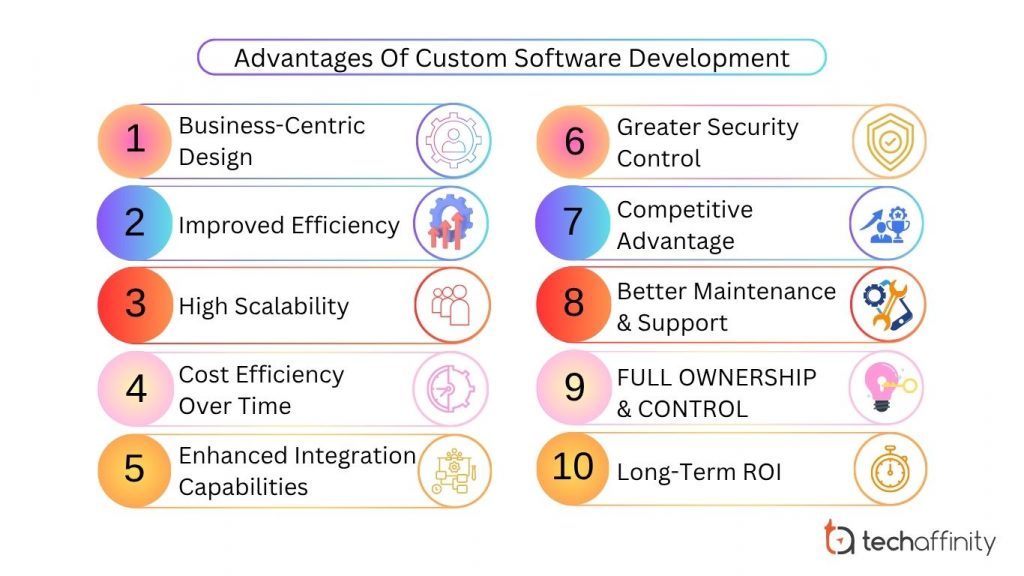
1. Business-Centric Design
Aligning Software With Business Processes
Custom software development begins with a deep understanding of your organization’s unique workflows, challenges, and objectives. Unlike generic solutions that force businesses to adapt their processes to fit the software’s limitations, custom applications are designed around your existing workflows.
This approach delivers process optimization through software that mirrors and enhances your current business processes, while providing role-based interfaces tailored to different user types within your organization.
The result is workflow automation that reflects your specific business logic and custom reporting capabilities that deliver exactly the metrics your business needs to make informed decisions.
Meeting Unique Enterprise Needs
Every enterprise has distinctive requirements that stem from their industry, company culture, regulatory environment, and customer base. Custom software addresses these specific needs rather than offering a one-size-fits-all approach.
For example, a logistics company might need real-time tracking capabilities integrated with their existing warehouse management system, while a financial services firm might require specialized compliance reporting features.
Custom software makes these unique requirements the foundation of the solution rather than afterthoughts.
2. Improved Efficiency
Automating Redundant Tasks
One of the most immediate benefits of custom software is the elimination of manual, repetitive tasks that drain productivity and increase error rates. By analyzing your current workflows, developers can identify opportunities for automation that directly impact your bottom line.
Common automation opportunities include data entry and validation processes, report generation and distribution, customer communication workflows, inventory management and reordering systems, and quality assurance checks.
This comprehensive automation approach transforms time-consuming manual processes into seamless, error-free operations that free your team to focus on higher-value strategic activities.
Streamlining Complex Workflows
Custom software excels at simplifying complex, multi-step processes that typically involve multiple systems and manual handoffs.
By creating integrated solutions that handle entire workflows within a single platform, enterprises can reduce errors, save time, and improve overall process reliability.
Consider your organization’s most time-consuming process. How many different systems does it currently involve? How many manual steps could potentially be automated?
3. High Scalability
Evolving with Business Growth
Custom software is designed with growth in mind, offering scalability benefits that evolve alongside your organization rather than constraining it. Unlike off-the-shelf solutions that may require expensive upgrades or complete replacements as your business expands, custom applications can handle increasing numbers of users without performance degradation while managing growing datasets efficiently.
This scalability extends to feature expansion capabilities that allow you to add new functionality without disrupting existing operations, and geographic expansion support that accommodates new locations and markets with localized features tailored to specific regional requirements.
Modular Architecture for Expansion
Modern custom software development employs modular architecture principles, allowing for incremental improvements and additions. This approach means you can start with core functionality and gradually add features as your needs evolve and budget allows.
This modularity also enables enterprises to test new features with limited user groups before full deployment, reducing risk and ensuring that additions truly meet user needs.
4. Cost Efficiency Over Time
Lower Operational Costs
While custom software typically requires a higher initial investment than off-the-shelf solutions, it often proves more cost-effective over time through several key areas of cost reduction.
Organizations benefit from the elimination of recurring licensing fees, reduced need for multiple software solutions, lower training costs due to intuitive business-specific interfaces, decreased reliance on external support services, and reduced operational overhead through intelligent automation. These cumulative savings often result in significant long-term financial advantages that far outweigh the initial development investment.
Eliminating Unnecessary License Fees
Off-the-shelf software often comes with licensing models that charge per user, per month, or per transaction. As your business grows, these costs can escalate significantly. Custom software eliminates these ongoing expenses, providing unlimited usage without additional licensing fees.
5. Enhanced Integration Capabilities
Connecting Legacy Systems and Modern Tools
Many enterprises struggle with integration challenges, particularly when trying to connect legacy systems with modern applications, but custom software can serve as a bridge that creates seamless connections between disparate systems.
This integration approach delivers significant advantages including real-time data sharing between systems, uninterrupted workflows across multiple platforms, extended life and value from existing legacy system investments, and easy integration with external services and APIs.
The result is a unified technology ecosystem where information flows smoothly and processes remain continuous regardless of the underlying system complexity.
API-First Approach in Custom Software
Modern custom software development prioritizes API-first design, ensuring that your application can easily integrate with current and future systems. This approach creates a flexible foundation that adapts to changing technology landscapes.
6. Greater Security Control
Building Security From the Ground Up
Custom software allows enterprises to implement security measures that align with their specific risk profile and requirements, rather than relying on generic security features that may not address unique vulnerabilities.
This tailored approach enables organizations to build robust protection through role-based permissions that match their organizational structure, custom encryption methods for sensitive information, comprehensive logging that meets specific compliance requirements, and security measures designed for their particular threat landscape.
The result is a security framework that provides exactly the level of protection needed without unnecessary complexity or gaps in coverage.
Compliance with Industry Regulations
Different industries face varying regulatory requirements, from HIPAA in healthcare to SOX in finance. Custom software can be designed with these specific compliance needs in mind, ensuring that regulatory adherence is built into the application’s core functionality rather than bolted on as an afterthought.
What industry regulations does your organization need to comply with? How does your current software help or hinder compliance efforts?
7. Competitive Advantage
Innovating Faster than Competitors
Custom software enables enterprises to implement innovative features and processes that competitors using standard solutions cannot match, translating into significant competitive advantages in the marketplace.
These competitive benefits manifest through unique functionality that competitors cannot easily replicate, faster time-to-market for new capabilities, superior customer experiences that differentiate your brand, and rapid market responsiveness that allows quick adaptation to market changes and opportunities.
This technological edge becomes a sustainable competitive advantage that compounds over time as your custom capabilities continue to evolve and improve.
Custom Features as a Market Differentiator
When your software capabilities are unique to your organization, they become a source of competitive differentiation. This is particularly valuable in industries where operational efficiency and customer experience are key differentiators.
8. Better Maintenance & Support
Direct Access to Development Teams
With custom software, you have direct access to the developers who built your system, ensuring faster response times, better understanding of issues, and more effective solutions when problems arise.
This direct relationship delivers significant support advantages including immediate response through direct communication with development teams, deep understanding from developers who know your system inside and out, flexible support arrangements that match your specific business needs, and comprehensive knowledge transfer through internal team training and documentation.
This level of personalized support is simply not available with off-the-shelf solutions where you’re typically routed through generic support queues.
Immediate Fixes and Feature Enhancements
When issues arise or new requirements emerge, custom software can be modified quickly without waiting for vendor approval or next release cycles. This agility is crucial for businesses operating in fast-paced environments.
9. Full Ownership & Control
Data Control and Intellectual Property
Custom software gives enterprises complete control over their data and intellectual property, unlike SaaS solutions where data resides on third-party servers and access depends on vendor policies.
This comprehensive ownership delivers significant benefits including complete control over where and how data is stored, full ownership of custom algorithms and processes that become valuable intellectual property, freedom of choice regarding hosting environments and providers, and guaranteed long-term access to your data and applications regardless of vendor relationships.
This level of control becomes increasingly valuable as data privacy regulations tighten and organizations recognize data as a strategic asset.
Independence from Vendor Lock-ins
Off-the-shelf software often creates vendor dependencies that can be costly and limiting. Custom software eliminates these dependencies, giving you the freedom to modify, enhance, or migrate your applications as needed.
10. Long-Term ROI
Measuring Returns Beyond Initial Costs
The return on investment for custom software extends far beyond simple cost savings and encompasses multiple components that contribute to long-term business value.
ROI measurement should include efficiency gains through time saved via automation and streamlined processes, revenue growth enabled by new capabilities that support business expansion, cost avoidance through elimination of licensing fees and operational overhead, competitive advantage reflected in market share gains from superior capabilities, and improved employee satisfaction resulting from better tools and more efficient workflows.
This comprehensive approach to ROI measurement reveals the true value of custom software investments.
Sustaining Growth Through Technology
Custom software creates a technology foundation that can support long-term business growth. Unlike off-the-shelf solutions that may become limitations as your business evolves, custom applications grow with your organization, continuing to provide value over time.
Custom vs Off-the-Shelf Solutions
When to Choose Custom Development
Choose Custom When:
- Your business processes are unique or highly specialized
- Integration with existing systems is critical
- You need specific compliance or security features
- Scalability and long-term growth are priorities
- You want to maintain competitive differentiation
- Off-the-shelf solutions require significant customization
When Off-the-Shelf Makes Sense
Choose COTS When:
- Your needs align well with standard software features
- Budget constraints limit custom development options
- Time-to-market is the primary concern
- Your business processes can adapt to standard workflows
- The functionality is not core to your competitive advantage
Flexibility Comparison
| Factor | Custom Software | Off-the-Shelf |
| Ongoing Costs | Lower (maintenance only) | Higher (licensing + upgrades) |
| Flexibility | Maximum customization | Limited to vendor features |
| Time to Deploy | 3-18 months | Days to weeks |
| Scalability | Designed for growth | May require new solutions |
| Integration | Seamless with existing systems | May require middleware |
| Support | Direct access to developers | Vendor support queues |
| Ownership | Full control and IP rights | Limited to usage rights |
Impact on Digital Transformation
Custom Solutions as a Catalyst for Digital Change
Custom software development often serves as the catalyst for broader digital transformation initiatives. By addressing specific pain points and demonstrating clear ROI, custom solutions can build momentum for organization-wide digital adoption.
Transformation Benefits:
- Process Digitization: Moving from manual to digital processes
- Data-Driven Decisions: Better analytics and reporting capabilities
- Customer Experience: Enhanced digital customer interactions
- Operational Efficiency: Streamlined workflows and automation
- Innovation Culture: Encouraging technological innovation throughout the organization
Empowering Cross-Department Collaboration
Custom software can break down silos between departments by creating integrated platforms that facilitate collaboration and information sharing.
Collaboration Improvements:
- Shared Data Access: Real-time access to information across departments
- Unified Workflows: Processes that span multiple departments
- Communication Tools: Built-in collaboration and communication features
- Visibility: Transparency into cross-departmental activities and metrics
Think about your organization’s biggest collaboration challenges. How could custom software help bridge the gaps between departments?
Conclusion
Custom software development represents a strategic investment in your organization’s future. While the initial costs and complexity may seem daunting, the long-term benefits from operational efficiency and competitive advantage to complete control and scalability make it an increasingly attractive option for enterprises serious about leveraging technology for business growth.
The key to success lies in careful planning, choosing the right development partner, and approaching the project with realistic expectations and clear objectives. By understanding both the benefits and risks outlined in this guide, you can make an informed decision about whether custom software development aligns with your organization’s goals and resources.
Partner with TechAffinity to Unlock Enterprise-Grade Custom Software Solutions
At TechAffinity, we don’t just build software, we engineer solutions that fuel enterprise growth. Our custom software development services are designed to align precisely with your workflows, scale with your ambitions, and adapt to evolving market demands. Leveraging cutting-edge technologies like AI/ML, cloud-native platforms, and modular API-first design, we help you create intelligent, secure, and future-ready systems. Whether you’re modernizing legacy processes or launching a new digital initiative, TechAffinity is your strategic partner in delivering software that works exactly the way your business needs it to.
The time depends on how big and complex the project is. Small projects take 2–4 months, while big ones can take over a year. Things like team size and features also affect the timeline.
Use clean, easy-to-read code and trusted technology. Write clear instructions and train your team. Keep the software updated to stay safe and useful.
Yes, it can be made to fit your current systems. It can connect with old software, outside services, and login tools. This helps everything work well together.
Make sure you have the code and clear documents. Involve your team during the project and use common tools. Your contract should say you own the code.
Check if it saves time, cuts costs, or helps you earn more. Also think about happier staff and better service. Being faster and more flexible is a big win too.